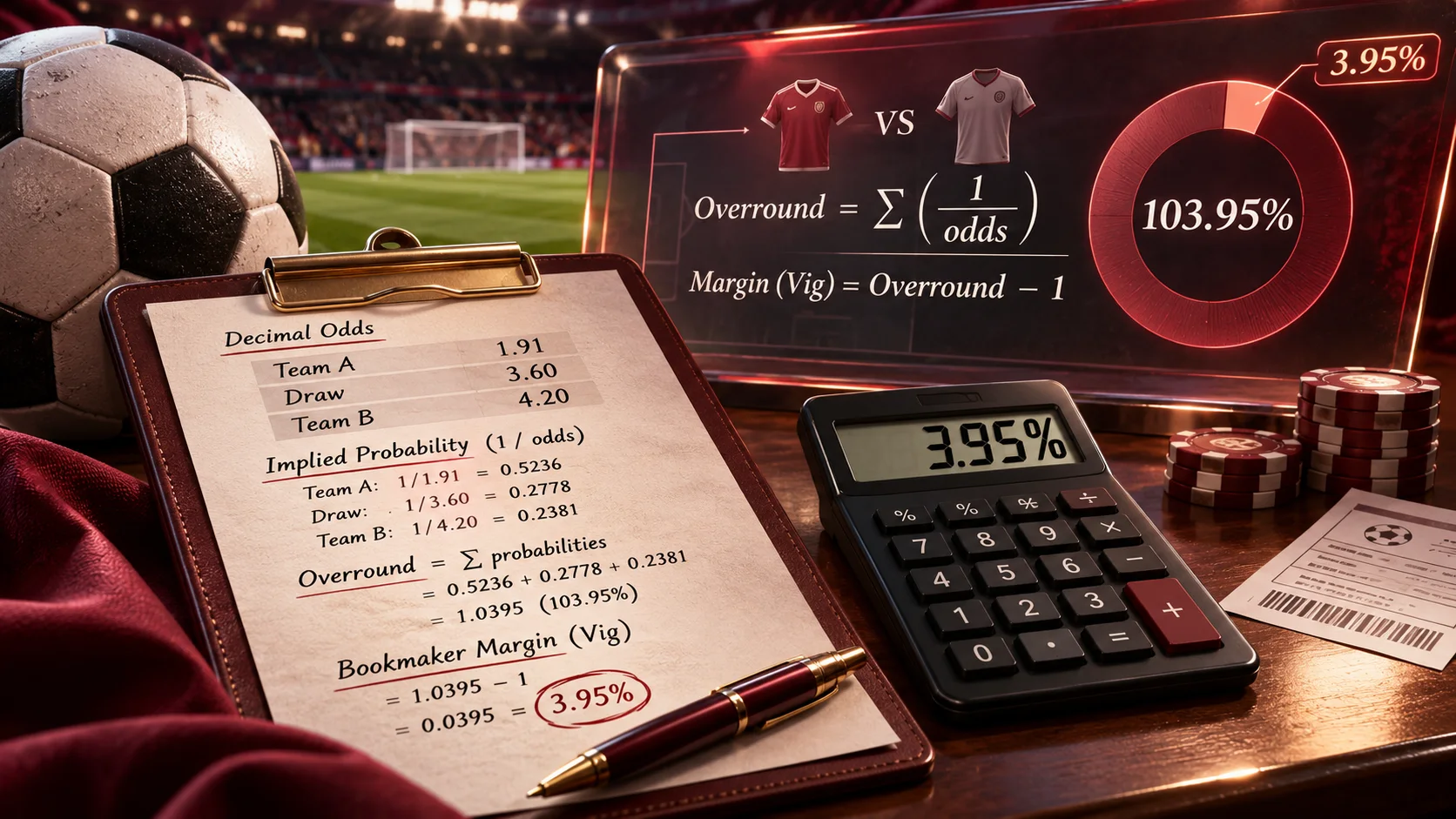
Bookmaker Margin and Overround: How to Calculate the Vig
Every price you see contains a small built-in cost called the margin, overround or “vig”. Knowing how to measure it is one of the most useful skills a bettor can learn, because it shows which markets offer better value. This Nova88 Official Website guide explains the formulas step by step, with worked examples for two-way and three-way markets.
Key takeaways
- Add the implied probabilities (1 ÷ decimal odds) of every outcome; anything above 100% is the overround.
- Two prices of 1.90 give 105.26%, an overround of about 5.3% and a payout percentage of 95%.
- Divide each implied probability by the total to estimate fair (no-margin) probabilities and fair odds.
- Main Asian Handicap and goal lines usually carry lower margins than correct score, specials and outrights.
- Margins multiply across parlay legs, which is why long parlays are expensive.

What is a bookmaker margin?
If a coin toss were priced fairly, both heads and tails would be offered at decimal odds of 2.00. A sportsbook would make no money in the long run. Instead, it might offer both at 1.90. The difference between the fair price and the offered price is the margin, also called the overround, vig or juice. It is how a bookmaker earns a return while staying balanced across many bets.
The margin is not a separate fee you see on the bet slip. It is built into every price. That is why learning to measure it matters: it tells you how much each market costs you on average, and helps you choose markets and prices that give you the best chance. Every market in the Nova88 sportsbook can be checked using the same simple formula.
A margin of a few percent may sound small, but bettors often place hundreds of bets a year. Over that many bets, the difference between a 3% and a 6% margin can decide whether a careful bettor finishes ahead or behind.
How to calculate the overround
The calculation has three steps:
- Convert each outcome’s decimal odds into implied probability: 1 ÷ odds.
- Add the implied probabilities of every outcome in the market.
- Subtract 100%. The result is the overround.
| Two-way market (illustrative) | Odds | Implied probability |
|---|---|---|
| Team A −0.5 | 1.90 | 52.63% |
| Team B +0.5 | 1.90 | 52.63% |
| Total | 105.26% |
The overround here is 5.26%. If your odds are displayed in Malay, Hong Kong or Indo format, convert them to decimal first; our Malay odds guide includes the conversion formulas.
Payout percentage: the other way to see it
Many bettors prefer to express the margin as a payout percentage, which shows how much of all money staked on the market would be returned if the bookmaker took balanced action on every outcome.
Payout % = 1 ÷ total implied probability. For the example above: 1 ÷ 1.0526 = 95.0%. The bookmaker’s theoretical hold is the remaining 5.0%.
Notice the overround (5.26%) and the hold (5.0%) are slightly different numbers describing the same prices. Both are fine to use, as long as you compare like with like. Higher payout percentages mean better value for bettors.
Margins on three-way (1X2) markets
The same method works for markets with three or more outcomes. A football match result market might look like this:
| Outcome | Odds | Implied probability |
|---|---|---|
| Home win | 2.10 | 47.62% |
| Draw | 3.40 | 29.41% |
| Away win | 3.60 | 27.78% |
| Total | 104.81% |
The overround is 4.81% and the payout percentage is about 95.4%. Three-way markets tend to have slightly higher margins than the two-way Asian lines on the same match, which is one reason many Malaysian bettors prefer Asian Handicap for match results.
Removing the margin to find fair odds
To estimate the “true” probability the market believes in, divide each implied probability by the total. This is called the proportional method.
| Outcome | Implied | Fair probability | Fair odds |
|---|---|---|---|
| Home win | 47.62% | 47.62 ÷ 104.81 = 45.43% | 2.20 |
| Draw | 29.41% | 28.06% | 3.56 |
| Away win | 27.78% | 26.50% | 3.77 |
Fair odds are useful benchmarks. If you believe the home team’s real chance is 50%, the fair price would be 2.00, and an offered 2.10 is attractive. If you think it is only 42%, 2.10 is poor value. Analysts also use more advanced methods that assign more of the margin to long shots, because bookmakers tend to price outsiders less generously, but the proportional method is a solid starting point.
Typical margins by market type
| Market type | Typical margin level | Why |
|---|---|---|
| Main Asian Handicap and goal lines on big leagues | Lowest | High volume and competition |
| 1X2 on big leagues | Low to moderate | Three outcomes, high volume |
| Smaller leagues | Moderate | Less information and liquidity |
| Correct score, HT/FT, scorers | Higher | Many outcomes, lower volume |
| Outrights and futures | Highest | Many outcomes, long time frames |
Exact margins vary by provider, event and time. The point is relative: if two markets express the same view, the one with the lower margin usually offers better long-term value. Our guides to correct score and HT/FT and outright odds show how higher-margin markets work.
Why margins compound in parlays
When you combine legs in a parlay, you multiply the payout percentages of every leg. A single 1.90 / 1.90 market returns 95% in theory; three such legs combined return about 0.95³ = 85.7%; five legs return about 77.4%.
| Legs | Combined payout percentage (95% per leg) | Effective margin |
|---|---|---|
| 1 | 95.0% | 5.0% |
| 2 | 90.3% | 9.7% |
| 3 | 85.7% | 14.3% |
| 5 | 77.4% | 22.6% |
This is the hidden cost of long tickets. Our mix parlay guide and weekly parlay tips explain how to keep parlays short and selective.
Margins in live betting
In-play markets move quickly and carry more uncertainty for the sportsbook, so live margins are often a little higher than pre-match margins on the same market. Markets also suspend briefly after goals and dangerous attacks. That does not make live betting bad value, but it does mean you should check the overround on live prices just as carefully as pre-match prices, especially for niche live markets such as next goal or corners.
How to use margin knowledge in practice
- Prefer lower-margin markets when two markets express the same opinion, for example Asian Handicap 0 instead of a higher-margin Draw No Bet line.
- Compare fair odds with your own estimate before every bet.
- Track your prices against the closing line, which is the market’s final, most informed price; see our closing line value guide.
- Keep stakes disciplined because even a good price can lose; our bankroll management guide explains unit sizing.
Common mistakes about margins
- Thinking the margin is “paid only when you lose”. It is built into every price, win or lose.
- Comparing odds formats directly without converting to decimal.
- Ignoring margins in many-outcome markets such as correct score or outrights.
- Adding parlay legs for fun without realising each one adds another layer of margin.
Checking margins on Nova88
The Nova88 site offers Asian Handicap, totals, 1X2 and many other markets through SABA Sports and other providers, so you can compare margins across markets on the same match.
- Sign in through the Nova88 Login page and open the sportsbook.
- Switch the odds display to decimal for easier calculation.
- Pick a match and note the prices for every outcome in two or three markets.
- Calculate each overround and favour the market that expresses your view at the lowest cost.
Frequently asked questions
What is overround in betting?
Overround is the amount by which the implied probabilities of every outcome in a market add up to more than 100%. It represents the bookmaker’s built-in margin.
How do I calculate bookmaker margin?
Convert each decimal price to implied probability with 1 ÷ odds, add them together and subtract 100%. Two prices of 1.90 give an overround of about 5.26%.
What is payout percentage?
Payout percentage is 1 divided by the total implied probability. Two prices of 1.90 give a payout percentage of about 95%.
How do I find fair odds?
Divide each outcome’s implied probability by the total implied probability to get a fair probability, then take 1 ÷ that number for fair odds.
Is a lower margin always better?
For the same view, yes: a lower margin means you keep more of the fair value. But a low-margin market is only worth betting if the price also beats your own estimate of the probability.
Which markets usually have the lowest margins?
Main Asian Handicap and goal lines on major leagues generally have the lowest margins. Correct score, specials and outrights tend to have the highest.
Why do parlays have higher margins?
Each leg carries its own margin, and the payout percentages multiply when legs are combined, so the effective margin grows with every added leg.
Responsible gaming. Betting carries a real risk of financial loss. Only stake money you can afford to lose, never chase losses, and take a break if betting stops being fun. Read the Nova88 responsible gaming policy for tools and support. You must be of legal age and permitted to gamble where you live.
Editorial note: odds, stakes and probabilities on this page are hypothetical examples for education only. They are not live prices, predictions or betting advice.
Keep reading on Nova88
Related Posts
 Sports Betting GuidesWeekly Parlay Tips: How to Build a Smarter Weekend ParlayNova88 weekly parlay tips: a step-by-step framework for building weekend football parlays, choosing legs, avoiding correlated picks and sizing stakes sensibly.Read guide →
 Sports Betting GuidesMalay Odds Explained: Positive, Negative & ConversionsHow Malay odds work on Nova88: positive and negative prices, how much you risk and win, converting Malay odds to decimal, HK…Read guide →
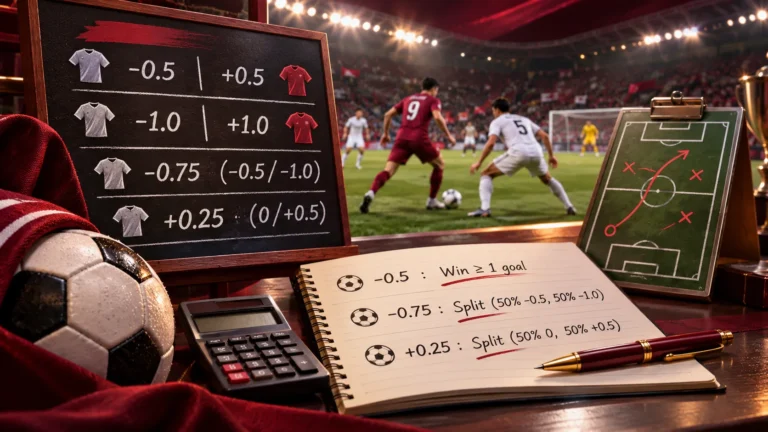 Sports Betting GuidesSABA Sports Asian Handicap Guide: Lines, Splits & ExamplesLearn how Asian Handicap works on SABA Sports at Nova88: whole, half and quarter lines, half-win and half-loss settlement, and how to…Read guide →